Keywordsai in everyday workBlogai for workai at workworkplace aiai for professionalshow to use ai at workai productivity
Related searcheschatgpt for email at workai for meeting notes at workusing ai for documents and presentationsai for workplace researchhow to use ai in daily workai in everyday work
The work that fills the week
Most professionals spend the week on connective tissue: the inbox, the meeting, the document that must be read before a decision, the deck that carries an argument into a room, and the research that is supposed to make that argument honest. If artificial intelligence is going to change knowledge work, it will do so here, or not at all.
Language models can compress the time it takes to summarise, structure, draft and compare. They cannot take responsibility for tone, for a commitment made in your name, or for a fact that turns out to be wrong. The unit of design is a workflow in which a model prepares, a human decides, and a named person sends. That is faster than doing the whole job by hand, and safer than letting the model speak for you.
Five workflows follow, each in the same shape: the job without AI, the job with it, what the human still must do, how to classify data before anything is pasted, the quality bar, two or three usable prompts, and the failures that appear once people start moving quickly.
Where the hours actually go
Time-use studies of knowledge workers keep returning the same picture. A large share of the week is consumed by coordination: reading and answering email, sitting in meetings, hunting for the latest document, assembling slides, and gathering enough background to speak with confidence. For many roles this is the work. The figure below shows a typical split. Percentages differ by function and seniority. The shape does not.
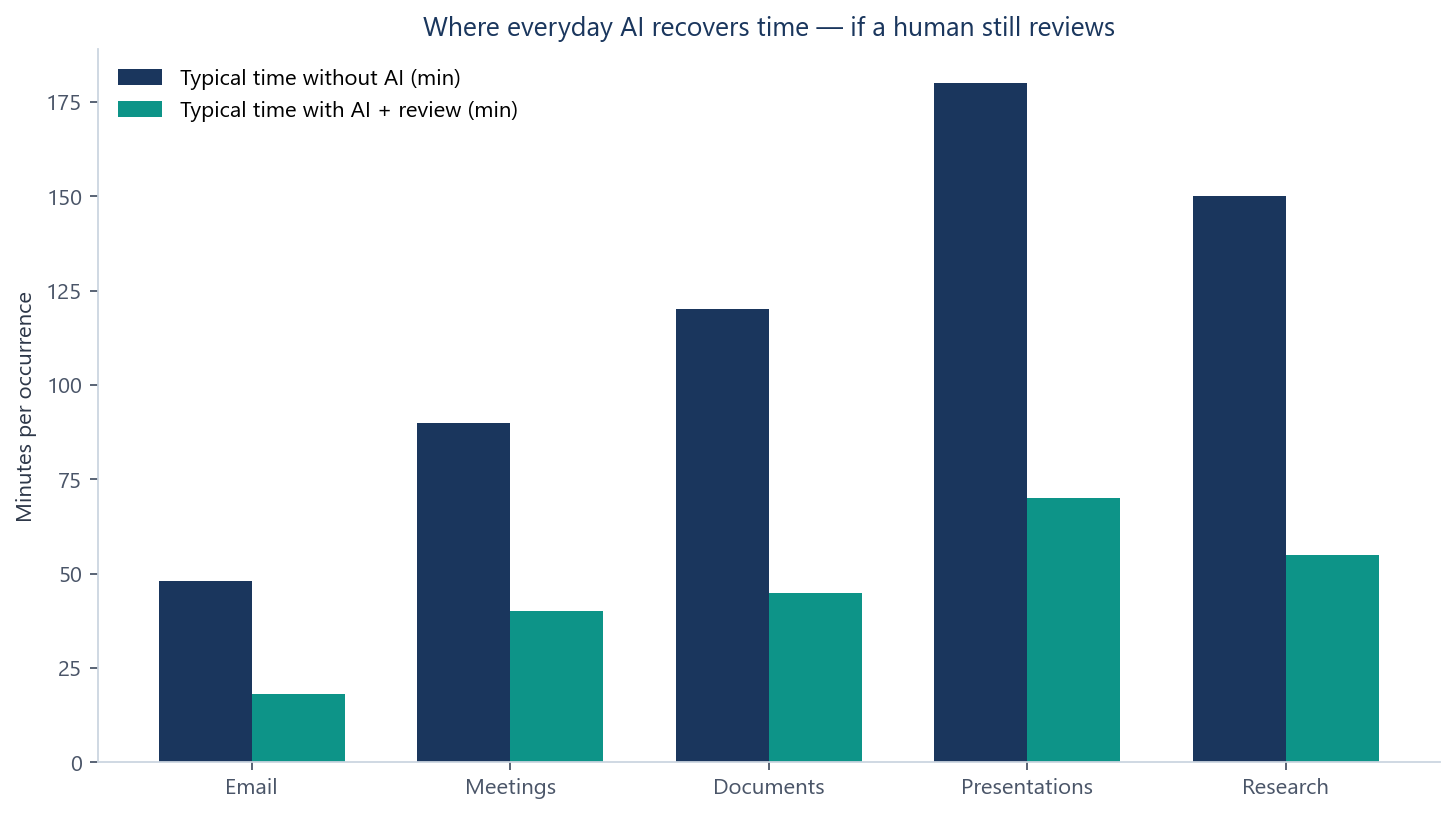
Two implications follow. A tool that only helps with analysis or strategy will miss the volume in email and meetings. And recovered time is not automatically valuable: if a model drafts thirty emails that still need a careful read, you have moved effort rather than reduced it. Map your week against the five bars, pick one workflow, run it for two weeks, and measure hours saved against errors caught.
Recovered time is a means. The end is better decisions, fewer dropped actions, and less rework. If a team uses AI to send more mail and schedule more meetings, the chart has been amplified, not improved.
An operating rule before the five workflows
Across all five workflows the same rule applies. The model drafts. The human reviews, then sends, files or presents. A language model has no standing to commit a budget, accept a deadline, or represent a client. The person whose name is on the message does.
| Stage | Model | Human |
|---|---|---|
| Prepare | Summarise, extract, structure, first draft | Choose the task, attach the right material, set the tone |
| Judge | Flag gaps, list options, critique a draft | Decide what is true, fair, and worth sending |
| Act | None. It does not send, file or present. | Send, schedule, commit, or reject |
| Own | None. There is no model on the org chart. | Named person, accountable for the output |
Classify the data before you paste. Internal process notes are not a client contract. A public annual report is not a draft board paper. Personal data, commercially sensitive figures, legal advice, or anything you would not put in a taxi does not go into a consumer chatbot. Use an approved environment, redact, or do the work without the model. The practical test: would you forward this thread to a vendor you have never met? If not, do not paste it.
Do not paste client secrets, personnel files, unpublished financials or anything under a confidentiality clause into a tool your organisation has not approved. Redact names and amounts when a summary is enough.
Email is the highest-volume surface in professional life, and unforgiving, because a message is a record. Tone, commitment and omission travel with the send button. It is a good first workflow: the pattern repeats all day, and the failure modes are easy to see.
Without AI, and with it
Without AI you read a long thread, piece together who promised what, draft a response, adjust the tone, proofread and send. Delay on a wandering thread is how deadlines slip. With AI you summarise the thread, identify the action required, draft a reply in the register you name, then review and send. You still decide whether the deadline is real, whether the missing figure is the right ask, and whether this should be a call instead.
| Step | Without AI | With AI |
|---|---|---|
| Context | Read the thread; reconstruct by memory | Summarise in five lines; list open points |
| Action | Infer what is being asked | Name the decision, the ask and the owner |
| Draft | Write from a blank box, then rewrite tone | Generate a reply in a specified register |
| Send | Proofread and send | Human reviews, then sends |
What the human still must do
You still decide whether a reply is the right medium. You still check that names, dates and figures match the thread, not the model’s reconstruction. You still own any promise: “we can deliver Friday” is yours once you press send. You still strip irritation, speculation and uncleared numbers from the record. And you still classify the thread before you paste it. A dispute with a client is not a lunch invitation.
The quality bar
A usable draft is short, names the action, matches the relationship, and contains no invented facts. If the thread never mentioned a budget figure, the draft must not invent one. If the correspondent is a regulator, it must not sound like a marketing note. Read once for substance and once for tone. If that takes more than a minute, the prompt was too vague or the thread should not have been delegated.
Prompts
The first prompt reconstructs and drafts in one pass. Use it when the thread is long and the ask can be named.
Summarize this thread in five lines and draft a reply confirming the deadline and asking for the missing budget figure.

Constraints:
- Do not invent dates, names, amounts or commitments that are not in the thread.
- If a fact is missing, ask for it; do not guess.
- Tone: professional, concise, no warmth that the relationship has not earned.
- Output: (1) five-line summary, (2) open actions, (3) draft reply of 80–120 words.
- Flag anything I should not put in writing.
A second prompt is for tone. Give the relationship and the outcome, not an adjective soup.
Rewrite this draft for a senior counterpart I do not know well.
Goal: decline the extra scope without closing the relationship.
Keep every factual claim. Cut preamble. No apology for having a process.
Output the rewritten email only, then a three-bullet note on the tone choices you made.
A third prompt is for morning triage, when the inbox is a pile rather than a single thread.
From these email subject lines and first sentences, group into:
(1) needs a decision from me today, (2) needs a short acknowledgement, (3) can wait, (4) should be a meeting not a reply.
For each item in (1), state the decision in one line and the risk of delay.
Do not draft replies yet.
Common failures
Wrong tone is the usual miss: too casual with a client, too stiff with a colleague, too eager to agree. Missing action is the second: a fluent note that does not confirm the deadline or name the owner is not a reply. The third is invented content. Models fill gaps — a meeting that was not offered, a figure that was not in the thread, an “as we agreed last week” that nobody agreed. If you cannot point to the fact in the source, delete it or verify it.
Never send a model-drafted commitment on the first read. Confirm the date, the owner and the number from the original thread. Then send.
Meetings
Meetings fail in two directions. Some are empty because nobody prepared. Others are full of talk and empty of decisions. AI does not fix a meeting that should not have been called. It can make preparation cheaper and make the record of a useful meeting usable the same afternoon.
Before, during and after
Before the meeting, draft an agenda, research the background, and prepare key questions. The model can turn a purpose statement into a timed agenda, pull public background into a one-page brief, and generate questions a chair would ask. It cannot decide whether the meeting needs to happen, who must be in the room, or what a good outcome looks like.
During and after, summarise the discussion, capture decisions and actions, assign owners and deadlines, and list open questions. Models are strongest here if the notes are real: a transcript, a chair’s scribbles, or shared bullets. A vague recollection is not enough. Feed the model a rumour of a meeting you missed and you will get a confident minute of a meeting that did not occur.
| Phase | Human sets | Model can draft |
|---|---|---|
| Before | Purpose, attendees, success criterion | Agenda, background brief, key questions |
| During | Chairing, listening, deciding | Live capture only if an approved tool is in the room |
| After | Who was actually there; what was actually agreed | Decisions, actions, owners, deadlines, open questions |
What the human still must do
You still decide the purpose. You still check the attendee list against reality: models invent people. You still confirm that a “decision” was a decision and not a mood in the room. You still assign owners who exist, with deadlines they have seen. You still keep confidential discussion out of unapproved tools. And you still send the note. A generated minute that nobody issues is not a record.
The quality bar
A meeting note is good if an absent colleague can see what was decided, who owns the next step, by when, and what remains unresolved. It is not a transcript or a compliment to the chair. It does not attribute views to people who did not speak, or turn a parking-lot comment into a workstream. If the model cannot distinguish a decision from a discussion, the note is not ready.
Prompts
Convert these meeting notes into decisions, action items, owners, deadlines and unresolved questions.

Rules:
- Use only names that appear in the notes. If an owner is missing, write OWNER UNASSIGNED.
- If a deadline was not stated, write DATE UNSET. Do not invent one.
- Separate decisions (agreed in the room) from suggestions (raised, not agreed).
- Output four lists: Decisions; Actions (owner, deadline, first step); Open questions; Items that need a follow-up meeting.
- End with two risks if these actions slip.
Draft a 30-minute agenda for this meeting.
Purpose: [paste one sentence].
Attendees: [roles, not a wish list].
Must-decide: [the one decision].
Must-not: status updates that could have been an email.
Output: timed agenda, pre-read of five bullets, and three questions the chair should ask if discussion stalls.Here is a transcript excerpt. Extract only:
(1) explicit commitments, with the speaker’s name as written,
(2) disagreements that were not resolved,
(3) numbers, dates and names.
Do not paraphrase a commitment into a stronger one. Quote the commitment in a short clause, then restate it in plain language.Common failures
Invented attendees are common: a director appears because that role “should” have been there. Missing actions are also common: the note reads well and names no owner. Wrong tone appears when the minute is written as a press release rather than as an operational record. The serious failure is converting discussion into decision. If the room said “we should look at this,” and the note says “Finance will deliver a paper by Friday,” you have created work that was never commissioned. Check every action against the source notes before the minute goes out.
Documents
Documents are where organisations store memory and obligation. Contracts, reports, policies, board packs: slow to read and expensive to get wrong. Models help because the tasks are bounded: summarise a long document; compare two versions; extract deadlines and duties; rewrite for a new audience; classify and tag; review for gaps and errors; translate; produce a first draft. None of that is the same as accepting the document as true.
What to use a model for
Summarising is the obvious use, and the one people over-trust. A fifty-page report reduced to one page for a manager is valuable only if the caveats, the numbers and the questions the manager will be asked survive. Comparing two versions is often more valuable than summarising one. Extracting deadlines and duties from a contract is valuable if you then check each extract against the clause. Rewriting for a new audience — technical to board, legal to operations — is valuable if the rewrite does not smuggle in a softer obligation. Classification, gap review, translation and a first draft all help, provided the author already knows the argument.
Two prompts from this family are worth keeping, because they describe the job more clearly than “please summarise.”
Compare these two contracts and list every material change.

For each change: clause reference in both versions, what changed, who it favours, and whether it alters money, liability, term, termination, data, or exclusivity.
Ignore formatting and defined-term reordering unless the definition itself changed.
If a clause appears in one version only, say so.
Do not opine on whether we should sign. That is my decision.
Summarize this 50-page report for a manager in one page.
Structure:
- What we were asked
- What we found (facts, with page references)
- What we recommend (clearly labelled as the authors’ recommendations, not as facts)
- Caveats and what would change the conclusion
- The three questions the manager is likely to get in the next meeting
Do not omit a negative finding to keep the page tidy.What the human still must do
You still choose the documents and the current version. You still refuse to paste privileged or client-confidential material into an unapproved tool. You still read the payment clause, the recommendation, the chart the board will see. A comparison list is a map, not the territory. Tell the model what “material” means for your purpose.
The quality bar
Every claim must be traceable to a page or clause. Recommendations are labelled as recommendations. “Not found in the text” is a legitimate answer; a fluent page with no references is not. For contracts you need clause numbers. For a managerial summary, a sceptical reader must be able to reach the source in two clicks. If they cannot, the summary is a new document pretending to be the old one.
A third prompt, for extraction and for gaps
From this document, extract every deadline, duty, and named owner into a table: item, who, by when, source clause or page, and whether it is a hard obligation or a best-efforts statement.
Then list gaps: duties with no owner, deadlines with no date, and terms that are used without definition.
If the audience is operations rather than legal, add a plain-language restatement of each duty in one sentence, without softening it.
Common failures
The usual failure is a summary that drops the uncomfortable finding. Models tidy a narrative. Missing action appears when a contract extract lists “the supplier shall” and never names who in your organisation must act. Wrong tone appears when a legal obligation is rewritten as a friendly suggestion. Invented attribution appears too: a recommendation given to “the committee” when the text said a working group “may wish to consider.” Read the source for every sentence you will rely on. The summary is a pointer.
Classify before you paste. Two client contracts are not a public PDF. If you lack a legal review environment, extract the clauses you need and work on the extract, not the full file.
Presentations
Someone asks for a deck. The model produces thirty text-heavy slides that restate the prompt. The room then sits through a document that should have been a paper. Use AI to structure the story, not to generate the pile. A presentation is an argument with a time limit. The work is choosing the argument.
A sequence that respects the room
Define the audience and what they need to decide. Develop the storyline. Create a slide structure — titles that carry the claim, not topic labels. Generate a key message per slide. Draft speaker notes. Critique the flow and cut what is weak. Simplify the complex parts. The model makes the middle faster. It does not know your audience. You do.
| Step | You provide | Model drafts |
|---|---|---|
| Audience | Who is in the room and what they must decide | A one-paragraph brief you then correct |
| Storyline | The claim you are willing to defend | A narrative arc and the order of evidence |
| Structure | Time limit and must-keep exhibits | Slide titles as full sentences |
| Notes and cut | What you will actually say | Speaker notes; a list of slides to delete |
What the human still must do
You still own the claim. You still check every number against the source. You still cut: a model will almost never volunteer that slide 14 is redundant. You still design for the room and refuse to paste unpublished figures into an unapproved tool. Speaker notes are not a script to be read while the audience reads the wall.
The quality bar
Each slide has one message. The title is that message. The exhibit supports it. The notes say what you will add that is not on the slide. If a slide cannot survive “so what?”, it is appendix material. If the deck cannot be told in ninety seconds without slides, the storyline is not ready. Fluency is not the bar. Argument is.
Prompts
Audience: [role] who must decide [decision] in [N] minutes.
Claim I will defend: [one sentence].
Evidence I have: [bullets, with sources].
Constraints: no more than 10 slides; titles must be full-sentence claims; no slide of only bullet text.
Output: (1) storyline in six sentences, (2) slide list with title, exhibit type, and key message, (3) two slides you recommend we cut and why.
Critique this slide outline for flow.
Identify: where the argument jumps, where evidence is missing, where we are repeating, and where a sceptical CFO will stop us.
Do not add slides. Propose cuts and reorder only.
Then write speaker notes for the three highest-risk slides: 80 words each, spoken register, no reading the title aloud.Simplify this explanation for a non-specialist board without losing the caveat.
Keep the number, the comparison, and the uncertainty. Cut jargon. If a term is unavoidable, define it in a clause, not a glossary slide.Common failures
Wrong tone: a sales-deck voice in a risk discussion, or a tutorial voice in a decision meeting. Missing action: a storyline that never states the ask. Invented audience: slides that address a generic “leadership” instead of the six people in the room, including the one who will object. The model will also invent exhibits — a chart that was never produced, a quote that was never said. If the outline refers to data you do not have, strike it.
Ask for titles as claims (“March margin compressed; cost, not volume, is the first place to look”) rather than as topics (“March update”).
Research
Research is the workflow in which models look most like oracles and fail most like improvisers. They can survey, structure and compare. They cannot, by themselves, know whether a claim is true. The professional pattern is a research design, not a chat. Define the question. Break it into subquestions. Identify sources. Compare competing viewpoints. Surface contradictions. Summarise findings. Identify knowledge gaps. Generate follow-up questions. Then verify important claims against the original sources, not against the summary alone.
Design first
A vague question (“what is happening in our market?”) produces a vague brief. A bounded question (“why did our win rate fall in the mid-market between January and April, and which explanations do we already have evidence for?”) produces work. Break it into subquestions a source could answer. Name sources you hold and sources you still need. Only then ask a model to compare viewpoints. Skip to the summary and you will get an essay about a market that may not be yours.
Competing viewpoints are where the model earns its place. Ask it to steel-man the case you dislike, and to list what would falsify the case you prefer. Ask it to surface contradictions rather than average them into a mush. Name the knowledge gaps, and the follow-up questions that would close them. None of this replaces the source or the person who was in the room.
What the human still must do
You still define the question tightly enough that a wrong answer would be detectable. You still choose sources, and you still open them. Verify important claims against the original — the table, the clause, the interview line — not against the model’s recap. Classify what you paste: a paid research note and a client interview are not public web pages. Research can be endless. The job is to know when remaining uncertainty is smaller than the cost of delay.
The quality bar
Every non-trivial claim has a source. Contradictions are listed, not smoothed. Gaps are labelled as gaps. Recommendations, if any, are separated from findings. If the model cannot provide a source, the claim is a hypothesis or it is out. “According to widely available information” is not a source.
Prompts
Research question: [one sentence].
Subquestions I already have: [list].
Sources I can provide: [list]. Do not invent citations.
Task:
1. Improve the subquestions; drop any that cannot be answered with these sources.
2. For each remaining subquestion, summarise what the sources say, with quotations or page references.
3. List contradictions between sources.
4. List knowledge gaps and the next source that would close each gap.
5. Do not recommend an action unless I ask in a later turn.
Here are two competing explanations of the same fact.
Steel-man each in 150 words. Then list the evidence that would distinguish them.
Do not tell me which you prefer. If the evidence we have cannot distinguish them, say so in one line.Take this summary you wrote and produce a verification list:
claim, where in the source I should check it, and what would make the claim false.
Mark any claim that cannot be checked from the material I gave you as UNVERIFIED.
I will check the UNVERIFIED items myself before anything is circulated.Common failures
Invented sources are the distinctive failure: papers that do not exist, experts who were not quoted, “studies show” with no study. Wrong tone: a research brief that sounds like a blog. Missing action looks like a failure to name the next check, as if the summary were the end of the work. The deeper failure is substituting the model’s synthesis for the source. For anything you will repeat to a client, a board or a regulator, open the original.
Verify important claims against original sources, not the summary alone. If you cannot open the source, you have a draft, not a finding.
Five workflows, one discipline
Email, meetings, documents, presentations and research look different in the calendar. They are the same job in the operating system. Classify the data. Bound the task. Demand structure. Read the draft against the source. Send only what you will own. Save prompts that survive real work. Measure minutes saved and errors caught. The next chapter applies the same discipline to numbers.
Key takeaways
- The daily surface is email, meetings, documents, presentations and research. That is where AI recovers time or adds volume.
- The model summarises, structures and drafts. A named human reviews, decides and sends.
- Classify data before you paste. Client secrets do not belong in an unapproved tool.
- Every workflow needs a quality bar: traceable facts, named actions, matching tone, and no invented people or numbers.
- Use AI to structure a presentation’s story, not to generate a pile of text-heavy slides.
- In research, verify important claims against original sources, not against the summary.