Keywordshuman and ai at workBlogai for workai at workworkplace aiai for professionalshow to use ai at workai productivity
Related searcheshuman in the loop at workwhat humans still own with aicomplementary work with aiai drafts humans decidehow to split work between humans and aihuman and ai at work
The advantage is a combination
This series has a through-line, stated in Chapter 1 and repeated because organisations keep forgetting it. The advantage does not come from owning a model. It comes from combining human judgement with AI capability, then making that combination repeatable. A team that uses a strong model as a faster typist will see modest gains. A team that redesigns the work so that models collect, draft and critique, while named people verify, decide and own, will see the gains compound.
Complementary labour is an old idea. Calculators did not abolish numeracy; they changed which numerical tasks were worth a human’s time. Spreadsheets did not abolish accounting; they moved accountants from arithmetic to judgement about what the arithmetic meant. Language models are doing something similar to text-heavy knowledge work. First drafts became cheap. Alternatives became cheap. Critique on demand became cheap. Taste, ethics, accountability and the decision under incomplete information did not become cheap. Those remain scarce, and they remain human.
The mistake is to treat the model as a colleague who almost does the job, and then to leave a thin layer of human “review” as theatre. Theatre is how organisations automate judgement without admitting it. Complementary labour is the opposite design. The model is given the parts of the work it is structurally good at. The human is given the parts the model cannot do, and is resourced with time to do them. If verification is squeezed to zero because drafting became instant, you have not adopted AI. You have lowered the quality bar and called it productivity.
Read this chapter as an operating model, not as a morale poster. “Humans and AI together” is only useful when you can say, for a given task, who collects, who drafts, who critiques, who verifies, who decides, and who owns the result.
What humans uniquely do
Start with the human side, because it is the side organisations undervalue once a fluent paragraph appears on screen. Models generate plausible text. Humans still set the destination, carry the duty, and live with the consequence. That is not a sentimental claim. It is a description of where the work actually sits.
Goal setting is human. A model can expand a goal you already have. It cannot tell you whether this quarter’s problem is margin, retention, safety, or a political fight you are pretending is a process issue. Choosing the goal requires knowledge of the organisation’s history, the incentives in the room, and the cost of being wrong. Those are not in the context window unless a person puts them there, and even then the person still has to choose.
Taste is human. Taste is the ability to say that a draft is competent and still wrong for this audience, this brand, this board, this moment. Models average toward the median of their training. Useful professional work often has to leave the median: a sharper recommendation, a quieter tone, a refusal to overclaim. Taste is trained by seeing many outcomes in a specific world. It does not arrive as a system prompt.
Ethics is human. A model can list stakeholder interests. It cannot take responsibility for a trade-off that harms someone. It will, if asked, produce a rationale for almost any side. That flexibility is useful in analysis and dangerous in decision. The ethical act is not generating the rationale. It is standing behind a choice when the rationale could have gone the other way.
Accountability is human, as Chapter 9 insisted. A model cannot be the sender. It cannot appear at a tribunal, face a client, or sign a filing. The person who publishes owns every claim. Complementary labour therefore includes the unglamorous work of being the owner: checking, declining to send, and putting a name on the document.
Tacit knowledge of the organisation is human. The model does not know that the last reorganisation failed because two directors do not trust each other, that the customer who looks small is politically important, or that a metric is gamed every December. Some of that can be written down. Much of it cannot, or will not be. People who have been in the building carry it. Briefs that omit it produce drafts that read well and land badly.
Stakeholder trust is human. Colleagues, clients, regulators and staff grant trust to people and institutions, not to a completion engine. A recommendation is accepted because someone credible will still be there if it fails. That is why rubber-stamping a model’s answer under your name eventually destroys the only asset the model cannot replace.
Deciding under incomplete information is human. Real decisions are made with missing data, conflicting testimony and a clock. Models can lay out scenarios. They cannot sit in the uncertainty and choose. They will often hide the uncertainty behind a tidy structure. The human job is to notice what is still unknown and to decide anyway, or to refuse to decide until a particular fact exists.
If a task is mostly goal setting, taste, ethics, accountability, tacit knowledge, trust or incomplete-information choice, the model is a staffer. It is not the principal. Design the workflow so the principal still has time to be the principal.
What models uniquely do
Models earn their place where scale, speed and tirelessness matter, and where the cost of a wrong first draft is low because a human will still check. That is a large part of knowledge work, which is why the tools spread so fast. It is not the whole of knowledge work, which is why unattended use goes wrong.
They draft at speed. A competent professional can outline a memo in an hour. A model can produce a structured draft in a minute, then another, then a third in a different tone. The scarcity shifts from words on the page to the quality of the brief and the quality of the edit. Chapter 4’s prompting discipline exists because the draft is no longer the bottleneck.
They search and pattern over large volumes of text. Given a stack of policies, transcripts or contracts that a human would skim badly at the end of the day, a model can propose clusters, exceptions and repeated clauses. It does not “understand” the pile in the human sense. It is very good at surfacing passages that look like the passages you asked for. That is useful if you then read the passages.
They generate alternatives. One of the most reliable professional uses is not “write the answer” but “give me four framings, two of which I will dislike”. Alternatives are expensive for humans because each one feels like a commitment. They are cheap for models. Cheap alternatives improve human choice, provided the human still chooses.
They critique on demand. A model will attack a draft, run a pre-mortem, or simulate a sceptical CFO without getting tired or politic. Chapter 7 covered that use. The critique is not the verdict. It is a structured second look that a busy person might skip. Skipping the human verdict afterwards is the failure mode, not the critique itself.
They never get tired of reformatting. Tables into prose, prose into slides, slides into a one-page brief, a brief into an email in a house style: this is work humans delay because it is dull. Models do not find it dull. Dull, reversible transformation is one of the highest-yield, lowest-risk uses in the series, always with a check that nothing was invented in the gaps.
| Strength | Humans | Models |
|---|---|---|
| Direction | Set goals, define done, choose the audience | Expand a goal already given; cannot originate organisational purpose |
| Production | Slow first drafts; high cost to explore variants | Fast drafts and variants; cheap reformatting |
| Pattern | Deep reading of a few sources; tacit context | Breadth over large text; no lived context unless supplied |
| Judgement | Ethics, taste, incomplete information, trust | Plausible arguments on every side; no duty |
| Stamina | Fatigue, boredom, political caution | Does not tire; also does not care |
| Ownership | Can be accountable | Cannot be accountable |
The operating model
Put the two lists together and the default operating model is almost obvious. AI collects, drafts and critiques. Humans verify, decide and own. Collect means gathering sources, extracting candidates, clustering, and proposing a first map of the material. Draft means turning that map into prose, tables or slides. Critique means attacking the draft on demand. Verify means checking claims against sources and against the world. Decide means choosing the recommendation, the number, the hire, the wording that will carry a name. Own means sending, filing, or refusing.
The split is not a conveyor belt that never folds back. A human still sets the brief before collection. A human may collect a source the model must not see, per Chapter 9. A model may be asked to critique again after the human has rewritten a section. The labels name the centre of gravity at each stage, not a ban on the other party touching the work.
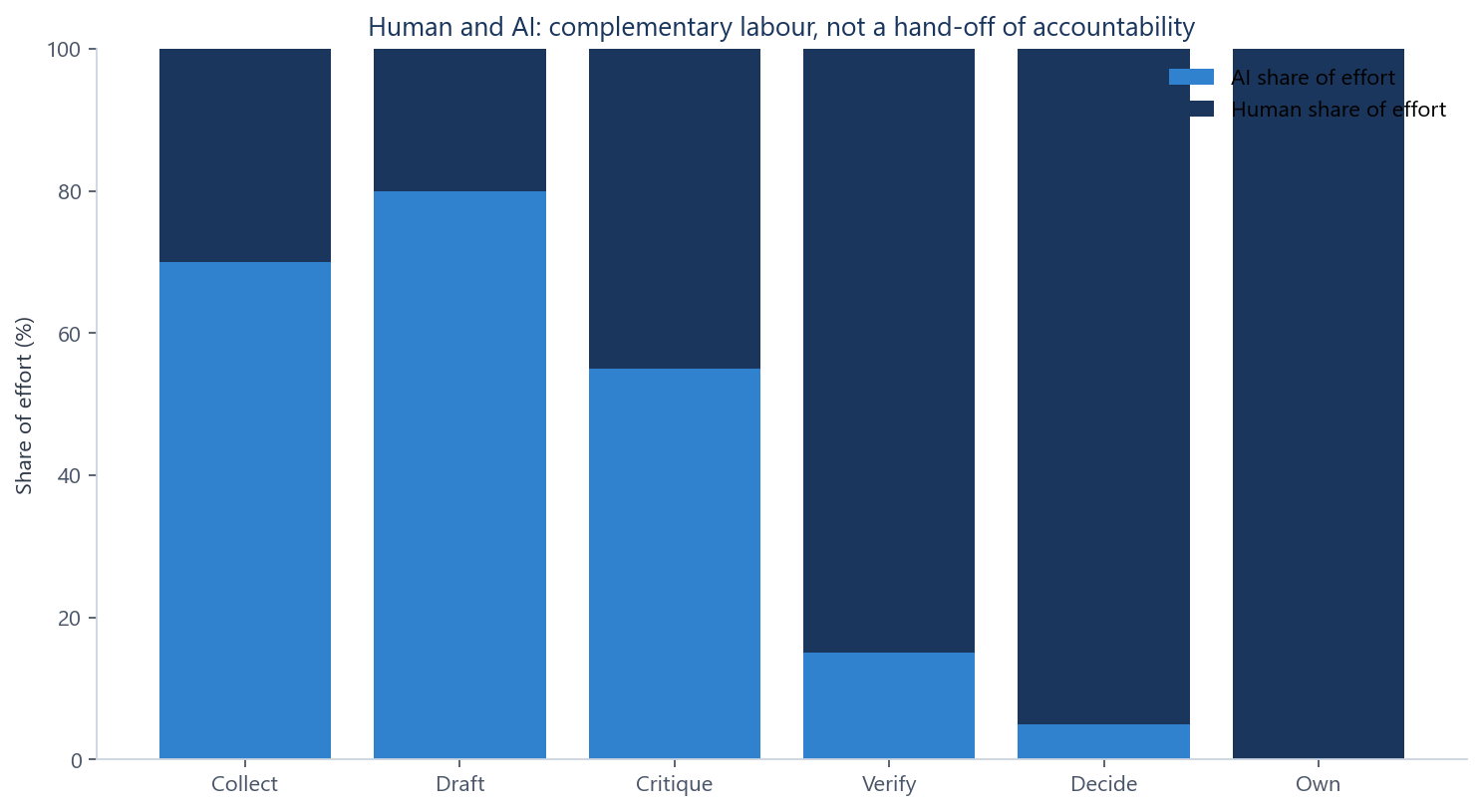
Read the chart as a warning as well as a design. If your week now spends almost no time on verify, decide and own, the model has not freed you for higher work. It has eaten the stages that make the work yours. Managers should look at calendars, not at demo videos. A team that produces three times as many first drafts and the same number of careful decisions has not become more strategic. It has become more verbose.
A practical sequence for a piece of analysis or a client document looks like this. The human writes a brief with role, task, context, constraints, output and quality checks. The model collects from the sources the human attached, staying inside the classification rules. The model drafts. The human, or the model under a human instruction, critiques. The human verifies every load-bearing claim. The human decides what the document will actually recommend. The human owns the send. Time saved on draft is spent, in part, on verify. If it is not, quality falls.
BRIEF FOR AI-ASSISTED WORK
Goal (one sentence):
Audience and decision this will support:
Sources I will attach (and their class: G/Y/R):
What the model should do: collect / draft / critique
What the model must not do: decide / send / invent sources
Constraints (tone, length, must-not-claim):
Verification I will perform before release:
Named owner (sender):
Date and tool:
Job design: unbundle, do not delete
The first instinct in a cost-pressure year is to delete roles because drafts got cheaper. That instinct misreads the technology. Language models unbundle tasks inside roles. They do not, on their own, remove the need for a person who can set goals, verify, decide and carry trust. Organisations that delete the person and keep the model keep the cheapest part of the work and discard the part that creates value.
Unbundling means looking at a job as a bundle of tasks, then moving the collect-draft-critique slice toward the model, and raising the standard of the remaining human slice. A policy analyst still exists. She spends less time producing the first ten pages and more time on the recommendation, the politics, and the evidence. A customer-operations lead still exists. He spends less time rewriting macros and more time on which exceptions deserve a human and which templates are allowed to run.
Raising the quality bar is the honest counterpart of cheap drafts. When first drafts were expensive, a merely adequate memo was a rational output. When first drafts are cheap, adequate is a choice to stop early. Clients and boards will not long pay professional rates for text that a general model can produce unaided. The human contribution has to be visible: a better question, a checked number, a decision that could not have been sampled from the internet.
This is also how you avoid a false war between “AI will take the job” and “nothing will change”. Some task bundles will shrink. Some roles will be redesigned around review, facilitation and exception handling. New coordination work appears: prompt libraries, evaluation, classification, vendor control. Design the work first. Then staff the work. A credible message to the team is: we are unbundling drafting from deciding; your value is increasingly in the stages the chart marks as human; we will measure errors caught and decisions improved, not words generated.
If you cut review time in the same week you introduce assistants, you are not running complementary labour. You are running a speed trial. Speed trials produce fluent error at volume.
The skills that travel
Complementary labour needs skills that most professional training still treats as optional. They are not technical in the machine-learning sense. They are professional habits with a new surface.
Briefing is the skill of Chapter 4, applied as job design rather than as a trick. A brief that names the role, the task, the context, the constraints, the output shape and the quality checks is how you stop the model inventing a product. People who cannot brief a junior colleague will not brief a model. The model merely makes the cost of a vague brief visible faster.
Verification is the skill of Chapter 3, practised until it is boring. Open the source. Recalculate the figure. Search for the citation. Read the clause the summary claims exists. Ask what would make this sentence false. Verification is slower than generation. That is the point. Organisations should praise people who catch errors, not only people who produce volume.
Process redesign is the skill of looking at a weekly workflow and moving collect-draft-critique without moving decide-and-own. It is closer to operations than to prompting. Who hands off to whom? Where does the audit line sit? Which steps can be parallel? Teams that only add a chatbot beside an unchanged process get a thin layer of speed and a thick layer of inconsistency.
Data classification is the skill of Chapter 9, exercised at the keyboard. Complementary labour collapses if the collect stage vacuums red data into a consumer tool. The person who briefs the model has to know what the model is allowed to see. That is now a core professional skill, like knowing what you may put in an email.
Facilitation of AI-assisted meetings is a new craft. The meeting is no longer only people talking. Someone is capturing, clustering, and projecting a live draft. Without facilitation, the room either ignores the tool or defers to whatever appears on the screen. With facilitation, the tool is used for capture and options, and the chair still calls the decision. The facilitator’s job is to keep the model in collect-draft-critique, and to stop the group from treating a generated list as a minute.
| Skill | Looks like, in practice | Failure without it |
|---|---|---|
| Briefing | RTCCOQ written before the first prompt | Generic drafts that invent scope |
| Verification | Sources opened; numbers re-run; claims marked | Fluent error shipped under a human name |
| Process redesign | A mapped chain with owners at decide and own | A chatbot taped onto last year’s process |
| Classification | Green / yellow / red chosen before paste | Shadow AI and unmanageable disclosure |
| Facilitation | Live capture without letting the screen decide | Meetings that rubber-stamp a generated list |
Failure modes
Complementary labour has characteristic ways of collapsing. They are easier to prevent if they are named.
Automation of judgement is the first. The organisation lets the model choose the hire, the credit, the medical priority, the fraud label, or the safety sign-off because the score looks precise. Precision of presentation is not a warrant. Chapter 9’s rule stands: never automate judgement about people, money or safety. The model may assemble the file. A named human decides, and can explain the decision without pointing at a probability.
Deskilling is the second. If juniors only ever edit model drafts, they never learn to produce a structure from a blank page, and they never learn what good verification feels like. Five years later the organisation has senior people who cannot tell whether a draft is empty. Complementary labour includes deliberate practice without the model: a weekly memo written by hand, a calculation run without assistance, a client meeting where the notes are taken by a person who must later reconstruct the argument.
Rubber-stamping is the third. Review exists on the process map. In reality, people glance and send, because the prose is fluent and the calendar is full. Rubber-stamping is how accountability becomes fiction. The cure is not a longer policy. It is a shorter output, a required source list, and managers who sample the work and ask “what did you check?”
Learned helplessness is the fourth. Staff wait for the model before they think. Blank-page anxiety, already common, becomes dependence. The team cannot operate when the vendor is down, and cannot operate when the task is too sensitive for the tool. A professional who can only work through an assistant is not complementary. She is captured. The operating model should assume the tool can disappear for a day and the work still happens, slower, at an acceptable standard.
A fifth mode sits next to these: role deletion without unbundling. The organisation removes people, keeps output volume constant, and hopes verification will still occur. It will not. Complementary labour is a staffing and time-allocation choice, not only a software choice. If you cannot describe how a new joiner will still learn the craft, your operating model is extracting skill from the present generation and not replacing it.
A RACI for AI-assisted work
RACI is a blunt instrument, which is why it helps here. Responsible does the work. Accountable owns the outcome and must be a person. Consulted is asked. Informed is told. A model can be used in the doing. It cannot be Accountable. It should not be the only Responsible party on verify, decide or own.
| Activity | Named human owner | Reviewer / colleague | AI system | Legal / security |
|---|---|---|---|---|
| Set the goal | A | C | C (options only) | I if regulated |
| Classify the data | A / R | C | — | C on grey / red |
| Brief the model | R / A | C | — | I if red data |
| Collect sources and extracts | A | I | R (within the brief) | C if connectors |
| Draft | A | I | R | — |
| Critique | A | C | R (on demand) | C on legal claims |
| Verify facts and numbers | R / A | C / R on high stakes | C (cross-check only) | C if required |
| Decide the recommendation | A / R | C | — | C if people, money, safety |
| Publish, send or act | A / R | I | — | I / C by policy |
| Keep the light record | R / A | I | — | I for audit |
Two cells are load-bearing. AI is blank on decide, publish and own. Legal and security are consulted when the data is red, the claim is legal, or the decision touches people, money or safety. Write names into the A and R cells before the first prompt. A RACI that names “the team” as Accountable names nobody.
How this connects to chapters 3, 4 and 9
This chapter is the operating model. Three earlier chapters are the reasons it has to look this way.
Chapter 3 established that models compose plausible answers. They are not search engines, not calculators you can stop checking, and not moral agents. Hallucination, bias, privacy leakage and contested ownership are managed, not solved, by better prompting. That is why verify is a human stage rather than a setting. If Chapter 3 were false — if models were reliable oracles — you could move decide into the machine. They are not, so you cannot.
Chapter 4 established that a prompt is a work brief. Role, task, context, constraints, output and quality checks are how a human transmits goal, taste and limits into a system that has none of its own. Complementary labour without briefing is an intern wandering the building. Complementary labour with briefing is a directed draft. The RTCCOQ loop is not a writing trick. It is the interface between human goal setting and machine production.
Chapter 9 established that classification, untrusted input and named accountability are the conditions of use. Collect and draft only happen inside a permitted tool, on permitted data. Critique does not include asking a consumer model to read a customer file. Own includes the duty not to send what you have not checked, and not to automate judgement about people, money or safety. The RACI’s blank cells for the model on decide and send are Chapter 9 drawn as a table.
Read together, the four chapters are one argument. Models are useful and limited. Usefulness depends on briefs. Limits are contained by verification and by governance. The human remains the principal. That argument is also the bridge into Chapter 11, which asks where value actually appears: not in isolated tasks, but in workflows redesigned around this split of labour.
If a proposed use of AI cannot cite how it handles hallucination (Chapter 3), briefing (Chapter 4) and classification plus ownership (Chapter 9), it is not ready. Complementary labour is the name for a design that can cite all three.
Running the combination week to week
Operating models die in the calendar. A team that agrees with this chapter and then books the week as wall-to-wall production will rubber-stamp by Thursday. Protect time for verify and decide as if they were client meetings. They are how the client is protected.
A workable weekly rhythm for a professional team is modest. On Monday, pick the pieces of work that will use assistance, classify the data, and write briefs. During the week, let the model collect, draft and critique inside the approved tool. Before each external send, run verification with the source open. On Friday, spend twenty minutes on the light record: where AI was used, what was checked, what error was caught. Caught errors are the leading indicator that the human stages still exist.
Measure the combination, not the tool. Hours returned on drafting are real only if error rates on released work do not rise. A team that saves four hours and ships two unchecked figures has not created value. A team that saves four hours, spends one on verification, and raises the quality of the recommendation has. Chapter 11 will treat measurement at programme level. At team level, a simple pair is enough: time to a checked draft, and defects found after send.
Keep a small library of briefs that worked, including the verification steps. Complementary labour is a craft. Craft accumulates in examples, not in slogans. Stay able to work without the model: a stronger human, not a dependent one. When the brief is clear, the data is classified, the draft is cheap, the critique is available, and a named person still verifies, decides and owns, you have the operating system this series has been arguing for.
Key takeaways
- The advantage is complementary labour: human judgement combined with AI capability, made repeatable.
- Humans uniquely set goals, exercise taste and ethics, carry tacit organisational knowledge, hold stakeholder trust, decide under incomplete information, and own the result.
- Models uniquely draft at speed, pattern over large text, generate alternatives, critique on demand, and reformat without fatigue.
- Default split: AI collects, drafts and critiques; humans verify, decide and own. Spend some of the time saved on verification.
- Do not delete roles by reflex. Unbundle tasks and raise the quality bar now that first drafts are cheap.
- The travelling skills are briefing, verification, process redesign, data classification, and facilitation of AI-assisted meetings.
- Watch for automation of judgement, deskilling, rubber-stamping and learned helplessness. The model is never Accountable on a RACI.
- Chapters 3, 4 and 9 are why the split looks this way: models are limited, briefs are the interface, and a named human remains the principal.