Keywordsthe ai opportunity at workBlogai for workai at workworkplace aiai for professionalshow to use ai at workai productivity
Related searcheshow ai changes knowledge workai opportunity at workhuman judgement combined with airedesign work with aiai acceleration vs process redesignwhy copilots underperform at work
The combination that matters
Most organisations already have access to capable language models. Access is not the scarce resource. The scarce resource is a way of working in which a professional can move faster without giving up the judgement that makes the work defensible. That is the AI opportunity in knowledge work: not a new department, and not a substitute for expertise, but a change in how search, analysis, drafting and review are sequenced.
The pattern is consistent across legal, finance, operations, product, human resources and consulting. Tasks that once took hours can be drafted in minutes. Analysis, alternatives, explanations and critiques can be supplied on demand. The largest gains, however, do not come from automating a single task. They come from rethinking the whole process so that the model does the work it is good at, a named human does the work only a human should do, and the hand-off between the two is explicit.
The advantage is not the model. The advantage is human judgement combined with AI capability, organised so that combination can be repeated every week rather than performed once in a workshop.
How AI changes knowledge work
Three mechanisms sit underneath almost every useful deployment. They are easy to confuse, which is why programmes that celebrate “usage” often fail to move cost, cycle time or quality. Acceleration is about time. Augmentation is about the quality of thinking a professional can bring to a problem. Redesign is about the shape of the work itself. All three can be present in the same week of work. Only redesign tends to show up as a durable change in how the firm operates.
It accelerates work
Acceleration is the mechanism people notice first. A solicitor who once spent an afternoon assembling a first-cut issues list from a data room can now obtain a structured draft in minutes, then spend the recovered time on the points that actually turn the deal. A financial analyst who used to rebuild a variance commentary from last month’s pack can start from a model-generated skeleton and spend the hour on the three lines that do not fit the story. An operations manager who compiled a daily exception report by hand can have the exceptions grouped, ranked and annotated before the stand-up.
Acceleration is real, and it is the easiest mechanism to overstate. Drafting in minutes does not mean the work is finished in minutes. The draft still has to be read. Sources still have to be checked. If the organisation treats acceleration as a licence to skip review, it has accelerated the production of plausible text, not the work.
It augments expertise
Augmentation is different. Here the model is not merely faster at a task the professional already knew how to do. It supplies analysis, alternatives, explanations and critiques that the professional can build on. A product manager can ask for five ways a pricing change might be received by a mid-market buyer, then discard three and pressure-test two. A human-resources business partner can ask for the arguments a works council is likely to raise against a shift-pattern change, then prepare answers that are specific rather than generic. A consultant can ask the model to attack the recommended option as a sceptical client would, and use the attack to strengthen the slide rather than to replace the recommendation.
This is close to what good colleagues already do: a second reading, a rival framing, a list of things that could go wrong. The difference is availability. That does not make the model a colleague. It has no stake in the outcome and no professional duty. Augmentation works when the expert remains the expert and treats the output as material to think with, not as a verdict.
It redesigns work
Redesign is the mechanism that creates the largest gains, and the one most organisations postpone. Instead of leaving the process as it is and inserting a chat window at the point of drafting, the team asks what the process would look like if search, summary, first draft, critique and formatting were assumed to be cheap. Handoffs change. Templates change. The definition of a “finished” first version changes. Review becomes a designed step with a named owner, not an afterthought squeezed into the last twenty minutes before send.
Consider a legal team that currently waits for a junior to produce a first memo, then a senior to mark it up, then a partner to approve. An accelerated version of that process is the same chain with a faster first memo. A redesigned version might start with a structured extraction from the contract set, a human confirmation of the extraction, a draft organised around the confirmed issues, a critique pass against the firm’s playbook, and a partner review that is shorter because the issues list was settled earlier. The hours saved are not only typing hours. They are hours of waiting, rework and last-minute discovery.
If your programme can only describe tools people have tried, you are still in acceleration. If it can describe a process that no longer exists in its previous form, you have started redesign.
Why isolated copilots underperform process redesign
The typical first deployment is a copilot: a chat pane next to email, a document, a spreadsheet or a browser. Individuals discover it, use it for the tasks they already own, and report that some of those tasks feel easier. That is not a failure. It is a weak form of the opportunity. Isolated copilots underperform redesign for structural reasons, not because staff are uninterested.
First, the unit of work in a copilot is the prompt, not the process. Value is trapped inside one person’s session. The next person doing the same weekly pack starts again. Prompts are not shared. Source files are not standardised. The review standard lives in someone’s head. Second, copilots inherit the existing process, including its delays and its duplicated effort. If four people each summarise the same board pack, four copilots will summarise it four times. Nothing in the tool notices the duplication. Third, copilots have no standing relationship with the systems of record. They see what was pasted. They do not see the contract repository, the incident log or last quarter’s actuals unless a person performs the integration by hand, every time.
Redesign attacks those three failures directly. The unit of work becomes a defined cycle: inputs, model-assisted steps, human gates, outputs, and a place where the prompt and the checklist live. Duplication is removed by producing shared intermediates, such as a canonical summary of the source pack that everyone else builds on. Integration is designed rather than improvised: the files the model is allowed to see are assembled on purpose, and the files it must never see are kept out on purpose. The copilot can still be the interface. It is no longer the operating model.
Traditional workflow and the AI-enabled sequence
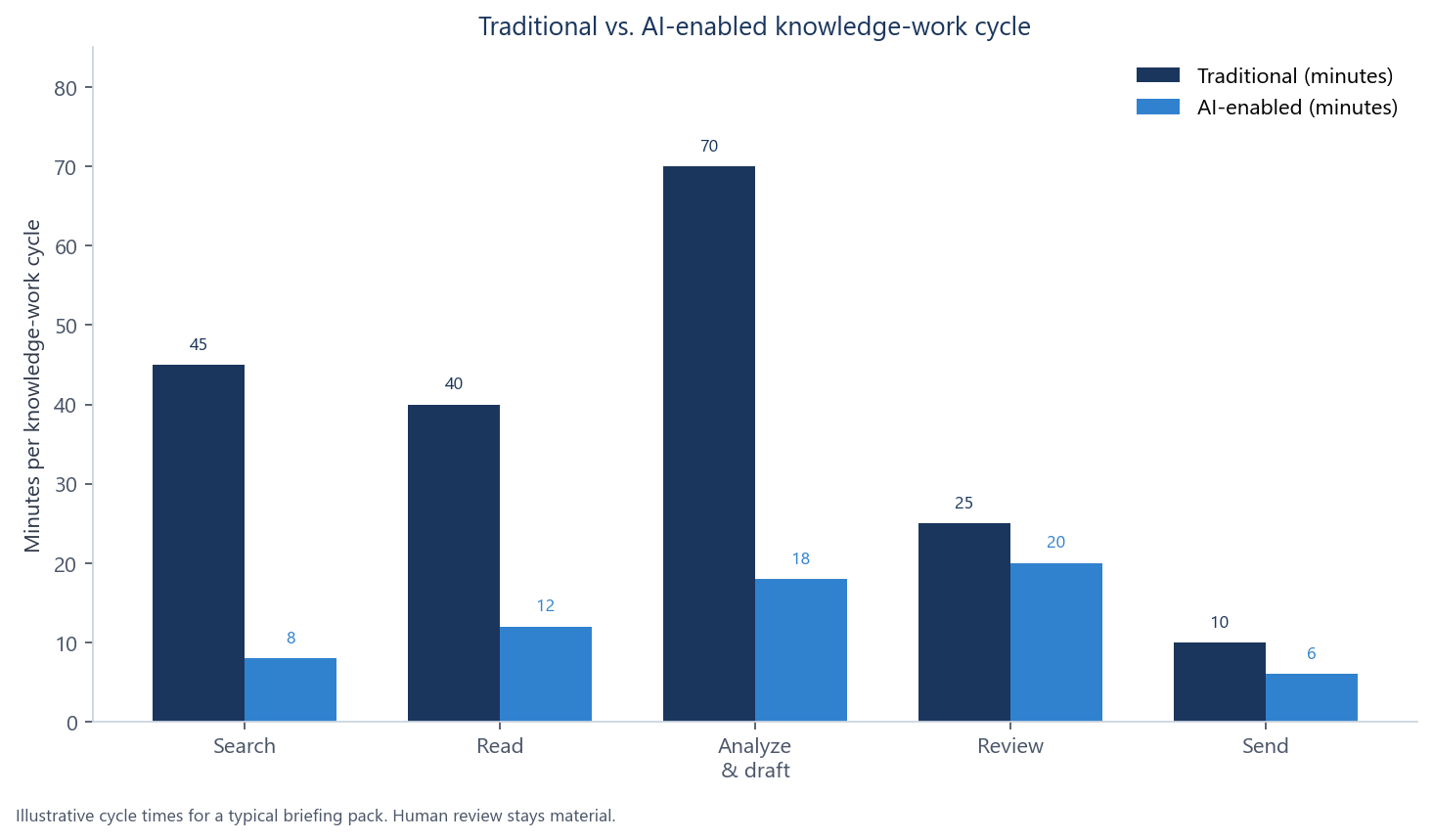
Knowledge work of a familiar kind still follows a sequence that predates language models: search manually, read documents, analyse and draft, review and format, then send. Search is slow because the material is scattered. Reading is slow because the relevant point is buried. Drafting is slow because the writer is also discovering the argument. Review is slow because the first version still contains unresolved questions.
An AI-enabled sequence does not delete those stages. It reassigns them. AI searches and organises. AI summarises and analyses. AI produces the first draft. AI critiques, and a human validates. AI finalises formatting and consistency. The human still decides what is true, what is allowed to leave the building, and what the recipient should do next. The chart below is illustrative rather than a promise. It shows where time typically moves, and it shows something programmes often omit: review remains material.
| Stage | Traditional sequence | AI-enabled sequence | What the human still owns |
|---|---|---|---|
| Search | Hunt across drives, inboxes and prior packs | AI searches and organises a defined set of sources | Which sources are in scope, and which are excluded |
| Read | Read linearly, highlight, take notes | AI summarises and flags likely issues | Whether the summary missed a clause, exception or number |
| Analyse and draft | Discover the argument while writing | AI produces a first draft against a brief | The recommendation, the audience and the risk posture |
| Review | Fix structure, facts, tone and format together | AI critiques; the human validates | Sign-off. A model cannot carry responsibility |
| Send | Format, version, attach, dispatch | AI finalises consistency and packaging | Who receives it, and what they are asked to decide |
“AI did the pack” is the wrong description even when cycle time has fallen by half. The pack is still a human product that used machine assistance at defined steps. Cut review in proportion to the drop in drafting time and you will ship faster errors.
Time recovered and time consumed by review
Every serious programme discovers a second clock. The first is time saved in search, reading and first-draft production. The second is time spent checking the output, correcting confident mistakes, and deciding whether the draft points at the right problem. Ignore the second clock and teams report productivity they do not have.
Review time is not a tax on AI. It is the price of using a system that generates plausible language rather than retrieving a stored answer. A junior associate who once spent three hours producing a slow, cautious draft may now spend twenty minutes prompting and forty minutes checking a fluent draft that looks senior. The net saving can still be two hours. The skill required of the reviewer has gone up, not down, because fluency conceals gaps that a clumsy draft used to advertise. In finance, a commentary that reads well can hide a mis-specified variance. In operations, a neat incident summary can omit the one alarm that did not fit the cluster. In HR, a polished policy explanation can flatten a legal distinction the original policy was written to preserve.
The practical response is to budget review as a first-class step and to make it cheaper without making it optional. Cheaper review has a method. Ask the model to cite the passage or cell it used. Ask it to list claims that are inferred rather than stated in the source. Ask it to produce a short “what I might have got wrong” list before you start reading. Compare the draft against a checklist that existed before the model, not against the draft’s own fluency. In legal work that checklist is issues, parties, dates, governing law and exceptions. In a weekly commercial pack it is movements, drivers, risks and decisions required. The checklist is how review stays shorter than the original drafting time without becoming theatrical.
Time recovered is not the same as time available. If the organisation fills every recovered hour with additional drafting, people will feel busier and quality will fall. Decide in advance whether recovered time is for deeper analysis, for more cycle volume, or for a smaller team. Do not leave that allocation to accident.
The quality and speed trade-off
Speed and quality are not automatically friends. A faster first draft improves quality when the extra time is spent on the parts of the work that benefit from attention: the ambiguous clause, the awkward stakeholder, the number that does not reconcile. A faster first draft damages quality when the extra time is spent producing more pages, more options and more versions that nobody can compare. The trade-off is therefore a management choice, not a property of the model.
In product work the failure mode is volume: more summaries than anyone can decide on. In consulting it is polish without a fact base. In legal and finance a fluent error can travel. A misstated covenant or a misplaced decimal is not redeemed by elegant prose.
A workable rule is to separate the standard of the draft from the standard of the decision. The draft can be fast and imperfect. The decision cannot. That means the organisation should be willing to accept a rough, well-sourced first version in an hour, and unwilling to accept a beautiful, unsourced recommendation in ten minutes. Where the work is internal and reversible, bias toward speed and keep a human in the loop for tone. Where the work is external, regulated or irreversible, bias toward verification and keep a human in the loop for truth. The same person can apply both standards in the same afternoon, provided they know which piece of work they are looking at.
Why organisations adopt: five levers
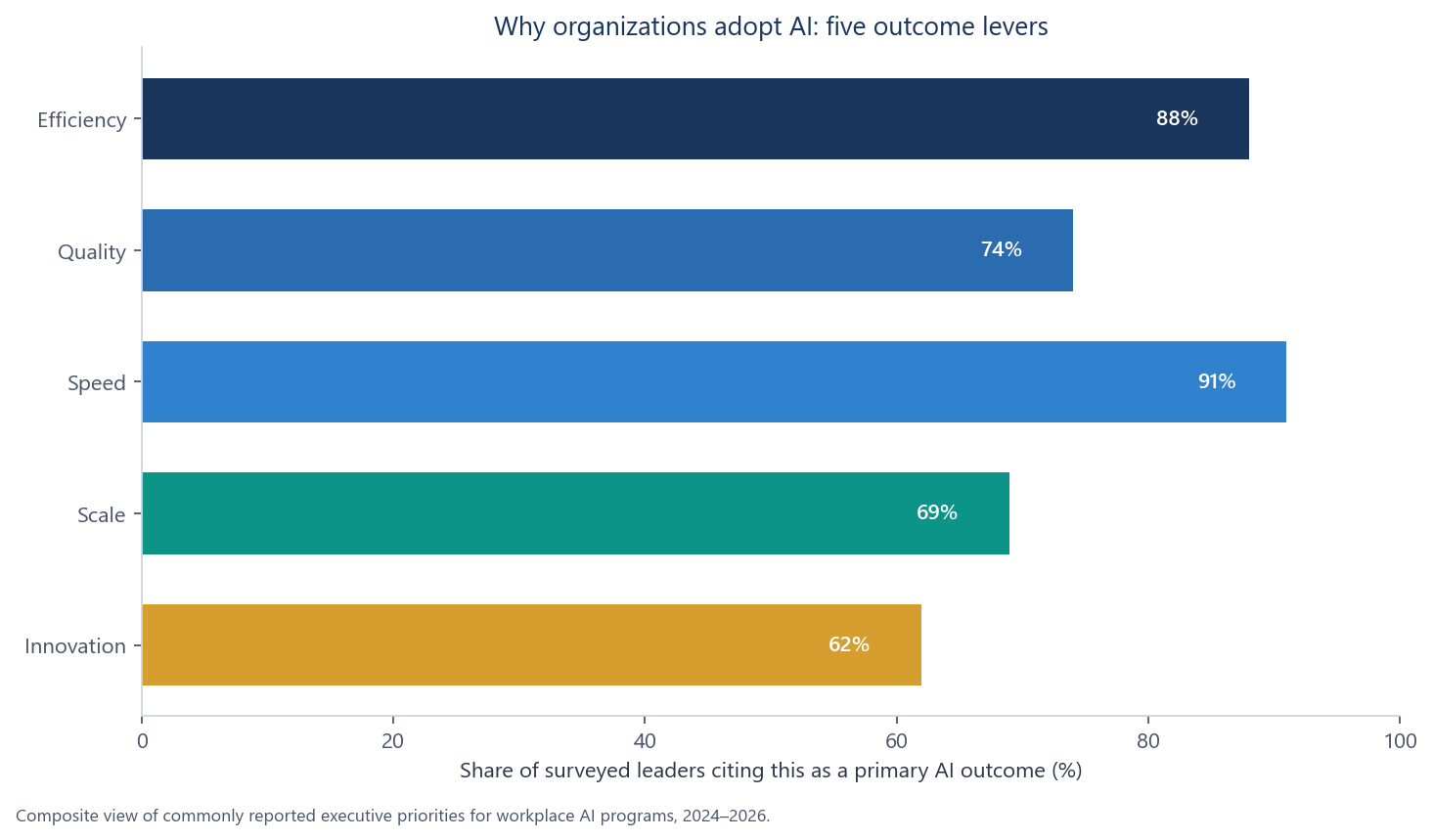
Organisations do not adopt workplace AI for a single reason. The recurring motives are practical: productivity across routine knowledge work; cost reduction where volume is high and variation is low; faster, better-informed decisions; more responsive customer service; faster research and knowledge retrieval; knowledge management at a scale a shared drive never achieved; automation of repetitive processes; broader employee capability, so a competent generalist can reach a first draft that previously required a specialist; room for work that was never on the list; and the ability to scale activity without a linear increase in headcount.
Those motives collapse into five levers: efficiency, quality, speed, scale and innovation. Efficiency is doing the same work with less effort. Quality is fewer errors, better structure and more consistent application of a standard. Speed is shorter cycle time from request to usable output. Scale is serving more customers, more employees or more markets without a matching rise in staff. Innovation is the new work that becomes possible once the old work no longer consumes the week. A programme that only reports hours saved is speaking to one lever. A programme that cannot say which lever a use case is for will struggle when two sponsors want different outcomes from the same tool.
| Lever | What it looks like in knowledge work | Typical false friend |
|---|---|---|
| Efficiency | Fewer hours per close, pack, review or ticket | Hours saved that are immediately filled with extra drafting |
| Quality | Fewer missed clauses, better structure, consistent tone | Fluent text that has not been checked against sources |
| Speed | Shorter time from request to a decision-ready artefact | Faster first drafts that wait just as long for approval |
| Scale | More customers or employees served with the same team | More volume without a designed review path for exceptions |
| Innovation | Time and attention for work that was previously crowded out | A backlog of new ideas with no owner and no decision rights |
The mix of levers changes by function. Legal operations often wants speed and quality of first-pass review. Finance wants efficiency in the close. Customer operations wants speed and scale. Product wants room for more than one framing of a bet. Consulting may want all five and capture none if partners treat the tools as a private convenience. Name the lever before you name the tool.
Who captures the surplus
When a weekly pack that used to take six hours now takes three, three hours have been created. Someone captures that surplus. If the individual keeps it as slack, the firm sees little in the accounts and the person may use it well or poorly. If the firm immediately loads three more packs onto the same person, the firm captures volume and the person captures fatigue. If the team uses the hours for deeper analysis of the two accounts that actually move the forecast, both can capture value. If the role is redesigned so that one person now supports two business units, the firm captures scale and the individual may capture a broader brief or simply a heavier one. The technology does not decide. The operating model does.
This is why “productivity” is an incomplete metric. Productivity for whom, and converted into what? In professional services the surplus often accrues first as a quieter Thursday, then as an extra iteration the client never sees, and only later as margin. In internal functions it often disappears into unmeasured responsiveness. That can be valuable. It can also avoid the harder conversation about which work should stop.
A durable arrangement is explicit: what share of recovered time returns as capacity, what share is reinvested in quality, and what share remains as professional discretion. If managers refuse that conversation, individuals will still decide, privately, how much of the gain to reveal.
A worked example: the weekly briefing pack
Take a concrete artefact. A commercial director receives, every Monday, a briefing pack: last week’s numbers, customer movements, operational exceptions, risks, and the three decisions the meeting must take. Traditionally a chief of staff spends most of Friday assembling it from emails, dashboards and incident notes, then issues it on Sunday evening.
An AI-enabled version starts on Thursday with a defined corpus: the dashboard extract, the incident log, the top customer notes, and last week’s pack as a template for structure, not as a source of facts. The model organises the material into the standing sections. It summarises each source and lists movements that exceed an agreed threshold. It produces a first draft of the narrative, including a short list of decisions required. It then critiques its own draft against a checklist: every number cited must appear in the extract; every risk must name an owner; every decision must be binary or multiple-choice, not a topic. The human validates the numbers, restores any political or commercial nuance the model cannot know, and signs the pack.
Role: You are a chief of staff preparing Monday's commercial briefing.
Task: Produce a first draft of the weekly pack from the sources I will paste.
Context: Audience is the commercial leadership team. They already know the strategy.
They need movements, exceptions, risks and decisions, not a restatement of the plan.
Constraints:
- Use only figures that appear in the dashboard extract. If a figure is missing, say so.
- Do not invent customer names, contract values or root causes.
- Keep the pack to six sections: headline, numbers, customers, operations, risks, decisions.
- Flag any claim that is an inference rather than a stated fact.
Output: A structured draft plus a short source map (claim → source).
Quality checks: Reconcile totals. List what you might have got wrong. Propose three decision questions.
Notice what has been redesigned, not merely accelerated. The sources are assembled before drafting begins. The template is stable. The critique pass exists even if the human is tired. The human’s scarce attention is spent on validation and on the political reading of the week, which no model possesses. The surplus might be used to add a two-page appendix on the one customer that actually threatens the quarter, which is quality, or to produce the pack by Friday noon, which is speed, or to cover a second business unit with the same analyst, which is scale. The team should choose.
The same pattern transfers. In legal, the “pack” is a matter status note: documents in, issues, dates, and questions for the partner. In HR, it is a weekly employee-relations digest: open cases, escalating themes, and decisions that cannot wait. In operations, it is the exception pack for the daily huddle. In product, it is the Monday insight note from interviews and support tickets. In consulting, it is the weekly workstream update. The artefact changes. The sequence does not: organise, summarise, draft, critique, validate, finalise.
What not to automate
Some work should not be handed to a model even when the model is willing. The test is not whether a fluent draft can be produced. The test is whether an error would be costly, whether the input is allowed to leave a controlled system, and whether the act of doing the work is itself the control.
Do not automate the final legal position on a live matter, the final number in a filing, or the final “we recommend” in a document that a client or a regulator will treat as advice. Assistance up to that point can be extensive. The last step is a named professional applying a duty of care. Do not automate the handling of material that cannot be pasted into a tool: unpublished earnings, identifiable employee health information, a customer’s unreleased strategy, credentials, or anything your classification policy already forbids. Do not automate performance judgements about named people, or disciplinary language, as if the model were a neutral observer. It is not. It will produce fluent characterisations from incomplete notes.
Do not automate work whose value is the thinking you would skip. A partner who never reads the contract, a product lead who never hears the customer, and a finance director who never looks at the reconciling items are not becoming more leveraged. They are becoming less informed. Models are particularly poor at noticing the thing that is missing: the email that was never sent, the risk that has no owner, the number that is stable because it is stale. Those absences are often the job.
- Final advice, filings, and recommendations that a third party will rely on.
- Any input your data classification policy forbids in an external or unapproved system.
- Irreversible actions: payments, access grants, production changes, public statements.
- Judgements about named employees, candidates or customers used as if they were findings of fact.
- Work whose whole point is that a responsible person has actually read the source.
If you cannot name the human who will be accountable when the output is wrong, you do not yet have an AI-enabled process. You have a way of producing text without an owner.
A ninety-day opportunity map for a team
A team does not need a transformation office. It needs a map that fits in a quarter and treats acceleration, augmentation and redesign as a sequence. The map assumes a team with a repeating weekly artefact: a pack, a close, a queue, a review cycle, or a client update. Adjust the artefact. Keep the discipline.
Days 1 to 30: see the work
List the repeating knowledge tasks that consume more than an hour a week. For each task, write down the inputs, the output, the current elapsed time, the current review path, and whether the material is allowed in the tools you have. Pick two tasks, not ten. Run them with AI in parallel with the old method. Measure net time, including review, and count errors caught. Share one prompt that earned its place. Appoint a named owner for quality, not a volunteer for enthusiasm. By day 30 you should be able to say, in one page, where time actually went and which lever you are pursuing.
Days 31 to 60: redesign one cycle
Take the better of the two tasks and redesign it. Define the corpus. Write the standing prompt. Write the checklist the human uses before sign-off. Decide what happens to recovered time. Stop producing the old intermediate if the new one replaces it; running both forever is how “pilot” becomes unpaid extra work. Brief the people who receive the artefact. One cycle, done properly, teaches more than a catalogue of experiments.
Days 61 to 90: make it the way the work is done
Move the cycle from “people who like the tools” to “this is how the pack is produced.” Put the prompt and checklist where a new joiner would find them. Log weekly what the model missed and what the human added. Only then consider a second cycle. Report against the five levers in language a sponsor can audit: hours, cycle time, error rate, volume, and any new analysis that previously did not exist.
| Window | Primary question | Evidence you should have at the end |
|---|---|---|
| Days 1–30 | Where does time actually go, and is the data allowed? | A task inventory, two measured trials, a quality owner |
| Days 31–60 | What would this cycle look like if first drafts were cheap? | One redesigned process with corpus, prompt and checklist |
| Days 61–90 | Is this now the default, and which lever moved? | Default operating rhythm, error log, lever report |
What to do this week
Choose one artefact you already own. Write the current sequence: search, read, analyse, review, send. Next to each stage, write what a model could draft and what you must still validate. Keep an honest log of review time. Name the lever the recovered time should serve.
The next chapter explains what sits behind the word “AI”: what these systems learn from, how they produce an answer, and where they stop being reliable. That understanding is what allows a professional to brief a vendor and to know when a confident sentence is only a confident sentence.